Is my model perplexed for the right reason? Contrasting LLMs' Benchmark Behavior with Token-Level Perplexity
Mar 31, 2026·,·
1 min read
Z. Prins
Equal contribution
,S. Punzo
Equal contribution
,F. Wildenburg
Equal contribution
,G. Cinà
S. Pezzelle
Abstract
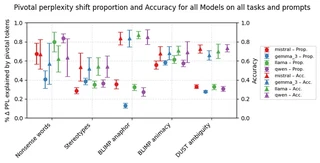
Standard evaluations of Large language models (LLMs) focus on task performance, offering limited insight into whether correct behavior reflects appropriate underlying mechanisms and risking confirmation bias. We introduce a simple, principled interpretability framework based on token-level perplexity to test whether models rely on linguistically relevant cues. By comparing perplexity distributions over minimal sentence pairs differing in one or a few `pivotal’ tokens, our method enables precise, hypothesis-driven analysis without relying on unstable feature-attribution techniques. Experiments on controlled linguistic benchmarks with several open-weight LLMs show that, while linguistically important tokens influence model behavior, they never fully explain perplexity shifts, revealing that models rely on heuristics other than the expected linguistic ones.
Type
Publication
arXiv preprint
This paper introduces a simple, principled interpretability framework based on token-level perplexity to test whether LLMs rely on linguistically relevant cues when solving benchmarks.
Key contributions:
- A hypothesis-driven analysis method using perplexity distributions over minimal sentence pairs
- No reliance on unstable feature-attribution techniques
- Experiments on controlled linguistic benchmarks with several open-weight LLMs
- Evidence that linguistically important tokens influence but never fully explain model behavior, revealing reliance on non-linguistic heuristics